Theatre of the 7 Directions - Google Ad Grant Case Study
Introduction To Theatre Of The 7 Directions
The Theatre of the 7 Directions is a nonprofit ecotheatre organization located near the Findhorn Ecovillage in Scotland. Their mission is to reconnect humans to themselves, and the rest of Nature, through the ancient art of performance.
The core activities of the Theatre of the 7 Directions are camps, programs, and performances for adults and children that promote a unique “ecotheatre” approach that’s designed to strengthen performance skills, help participants connect with nature, and improve mental health.
They attract an international audience across a huge age range with participants flying from all over Europe and across the United States to attend.
Google Ad Grant Goals
The Theatre of the 7 Directions wanted to use the Google Ad Grant to:
- Find more teens and adults for ecotheatre camps starting throughout the month of July
- Find attendees from across the world with a focus on Europe and the United States.
With so many locations to target and different age ranges for different camps, we immediately knew the proper segmentation and account structure would be critical to success!
Overall Results
The ecotheatre camps started in July but we didn’t get access to the account until late May. Google Ad Grant accounts are slow moving and while they’re great for events, you want to give yourself as much lead time as possible.
We didn’t have that luxury here, but we were still able to get the account scaled quickly as you can see from the screenshot below:
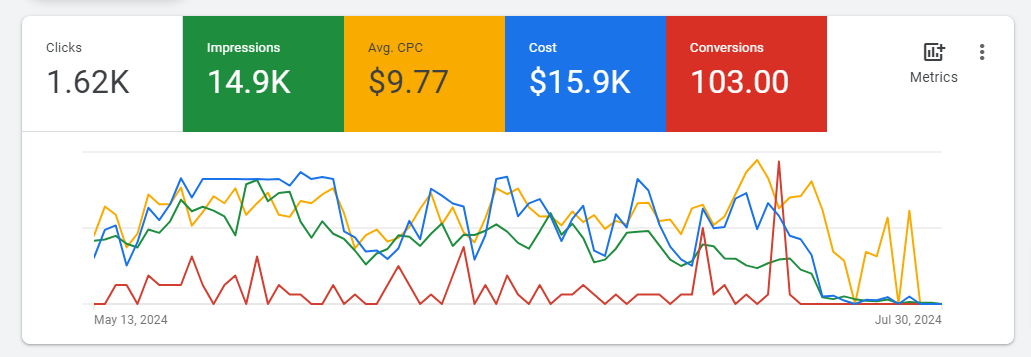
We ran the account from mid-May to the end of July and were able to generate a total of 103 conversions in the form of contacts to schedule or enhanced interest in a specific camp.
The biggest challenge was the short amount of time we had to get results. It’s not uncommon for Google Ad Grant accounts to take a week (or more) to really start to scale and with less than 60 days until the first camp time was not on our side.
The advantage we had was experience in the retreat and summer camp space as well as a large geographic area to target both of which allowed us to find success despite the tight timeframe.
Logan is an exceptional professional. He managed to bring a lot of traffic to our website in very short time while paying attention to details and making sure we don't lose our identity in the process. He is extremely reliable, trustworthy, passionate and generous with his time.
Laura Pasetti, Founder and Artistic Director for The Theatre of the 7 Directions
Process and Strategy
The massive geographic region that we could run ads in helped us, but it also added some extra complication to this Google Ad Grant account. We also had the challenge of a very unique camp type (ecotheatre) that didn’t have much direct search volume.
Let’s look at how we handled both issues.
Keyword Selection
One of the big benefits of Google Search Ads is the ability to capture intent.
But when your offering is too unique, you may not have any search volume. That was the case here and no one was truly searching for “ecotheatre camp” which has a monthly search volume of 0 according to Google Keyword Planner.
That means we had to target relevant and closely related keywords and then make sure our user understood what was different about our camp offer. Because the camps had a restorative and wellness component to them along with a focus on nature, we targeted keywords like:
- Nature camp
- Wellness retreat
- Eco retreat
Additionally, we targeted keywords like “summer camp” but needed to have variations like the ones above to avoid extremely competitive terms and round out the account. In addition to conversions for terms like “summer camp” or “teen summer camp” we also generated conversions from search terms like “depression retreat” and “mental health retreat”.
This highlights how keyword selection is critical for maximizing a Google Ad Grant account and the need to look beyond the most obvious (and usually most competitive) keywords.
Even with a broad (but still very relevant) keyword targeting we were able to achieve a 10.82% clickthrough rate which is well above the Google Ad Grant requirement of 5%.
Audiences and Location Targeting
The other layer we had to consider on this account is the location targeting. We had campaigns targeting both U.S. and several countries in Europe.
This adds further segmentation but was needed since the phrasing used by people in each major location (like U.S. compared to Europe) can be quite different. For example “residential theater camp” will make sense in Europe but that would be more commonly called an “overnight theater camp” in the United States. To keep our clickthrough rate high, we want to make sure our ads are using phrases that make sense for that region.
But too much segmentation can lead to too few conversions per campaign so to prevent that we utilized a portfolio bidding strategy which allowed us to share conversions across all of our campaigns. This structure allowed for easier management, better conversion data for Google and better results overall.
Moving Forward
Summer camps are a competitive space with plenty of paid and grant accounts competing for conversions. But with strategic account structure, segmentation, keyword selection we were able to achieve impactful results over a short period of time.
We also have data on what works and what doesn’t so that future Google Ad Grant campaigns for camps can be launched even more quickly and with even better results. The Theatre of the 7 Directions plans on running more events and leveraging the Google Ad Grant to attract international attendees.
If you want to see similar results for your organization, check our nonprofit marketing blog for more information on how you can do it yourself or book a call to discuss how to leverage Google Ad Grants for your non-profit’s growth.