Why Google Ad Grants Struggle With Competitive Keywords (Dual Auction System Explained)
You may have heard that Google Ad Grants are “only good for awareness” or that they “struggle to show up for competitive searches”. This is generally, but not always true, and understanding why will give you a much better insight into what this really means and how it impacts Google Ad Grant effectiveness.
It all comes down to the dual auction system that Google uses to determine the placement of free or grant ads compared to paid ads.
Google Ad Grant ads show up after paid ads and for highly competitive searches (like those related to donations) there might not be any advertising space left for grant ads to take. As a result, you’ll see very few or even no impressions.
That means it’s more accurate to say that Google Ad Grants struggle with highly competitive keywords, but that doesn’t mean they’re only good for awareness as a result. We’ve regularly used the Google Ad Grant for a wide range of strategies including promoting events, local services, list building and much more.
Let’s take a closer look at exactly how this dual auction works.
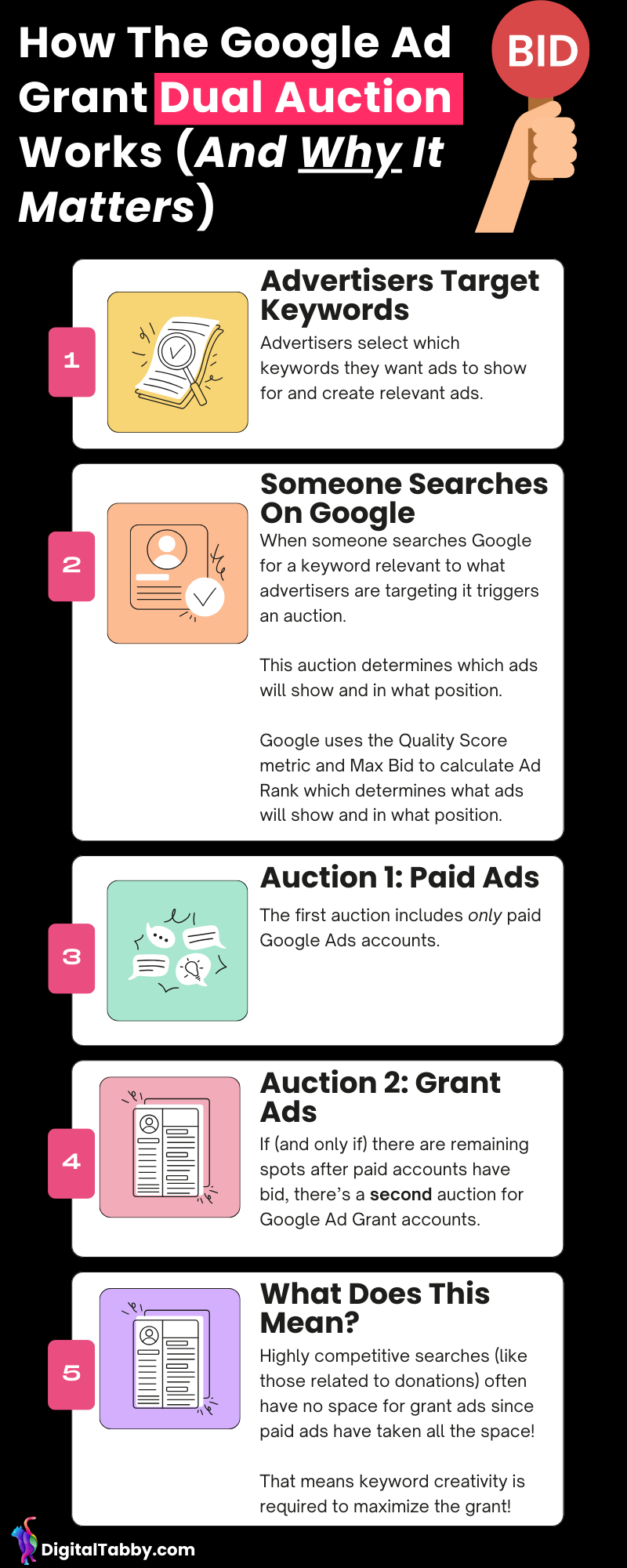
Understanding The Dual Auction Process
We’ll start by breaking down the auction process step by step.
1. Advertisers Target Keywords
Everything starts with keywords.
Advertisers (both paid and grant) select keywords they want their ads to show for and create relevant ads to match those keywords.
2. The Search Trigger
When someone searches on Google using terms that match your keywords, it triggers an auction.
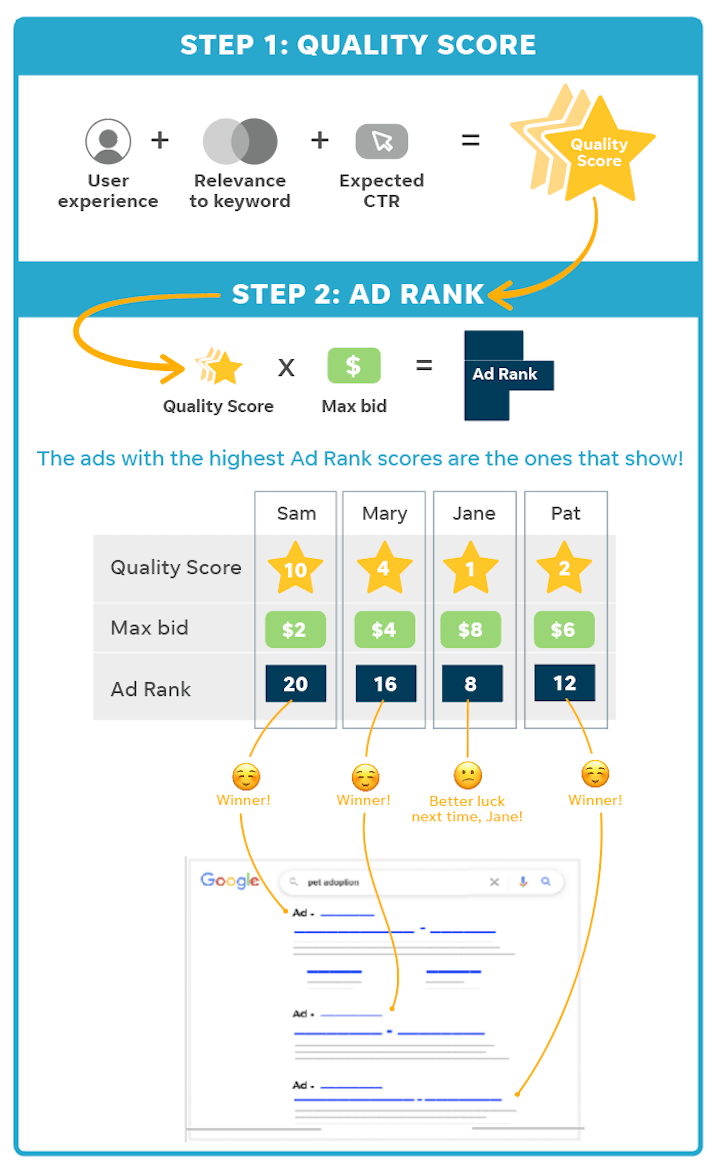
In this auction, each advertiser bids on the keywords they want to target. But unlike a traditional auction where the highest bidder wins, Google uses Quality Score and the maximum an advertiser is willing to pay to create their Ad Rank score.
Because Quality Score uses relevance factors like Landing Page Experience, Expected CTR, and Ad Relevance it allows Google to give extra ranking power to the most relevant advertiser. In other words, it’s not just your bid that matters but instead your bid and your relevance to the search term.
This graphic from WordStream does a great job explaining this and notice how the advertiser with the highest bid isn’t necessarily the one with the best ad position:
3. First Auction: Paid Accounts Only
The first auction includes only paid Google Ads accounts. If there’s a lot of competition, paid accounts will potentially take all the available ad spots.
4. Second Auction: Grant Accounts
Only after the first auction completes does Google consider grant accounts.
The crucial detail here is that grant accounts only enter this second auction if there are remaining ad spots after paid accounts have finished bidding. If paid accounts take all the available spots, there will be no second auction for grant accounts since there’s no space to bid on.
Why This Matters For Your Google Ad Grant
Highly competitive searches (like those related to donations) often have no space for grant ads since paid ads have taken all the available positions. This is why targeting “donate cars” or similar high-competition terms rarely works well in grant accounts.
When keywords have a very high-intent (like “donate car” or “donate for cats”) they’ll often have more competition. One of the ways around this is to focus on keywords with lower, but still highly valuable intent. That could be something like “how to help cats” or “what to do with an old car”.
This video explains a specific example used for HeroBox:
Should You Have Both A Paid And A Grant Account?
Nonprofits are often concerned that having both paid and grant accounts will lead to competition, and higher cost per click, for both accounts.
But now that we understand the dual auction system, we see that this isn’t an issue.
Instead, the dual auction system actually creates a unique opportunity to run both paid and grant accounts without them competing against each other. Since they operate in separate auctions, running both accounts won’t drive up costs. This allows you to use each account type strategically:
- Your grant account can focus on lower intent (but still valuable) keywords to avoid competition.
- Your paid Google Ads account can target those high-intent, competitive searches where grant ads struggle to show like donation or revenue generating searches.
This combination gives you the best of both worlds, complete keyword coverage without internal competition. Many nonprofits also layer in meta ads for nonprofits to capture demand that doesn’t show up in search at all, like prospective donors and event attendees on Facebook and Instagram.
The Bottom Line
Understanding the dual auction system is crucial for understanding why grant accounts can struggle with some (but not all) competitive terms. However, the details matter and what paid advertisers are targeting can vary wildly between advertisers.
Remember: your goal isn’t to outbid paid advertisers (you can’t), but to find the valuable keywords they’re not targeting. This might require more creativity and testing, but it’s the key to maximizing your grant within Google’s dual auction system.